
General contact lens questions

Wearing contact lenses should not hurt, especially when properly fitted and conditions are normal. A contact lens can hurt if you trap dirt or dust between your eye and the contact lens. Take them out and clean them with multi-purpose solution. If the problem does not go away, throw out the contacts and try a fresh pair. Also, if you scratched your cornea at any time, it will hurt when you put in a contact lens. Though frankly, if you’ve scratched your cornea, you’ll probably already know it and will not want to go near your contacts until it has healed. Aside from that, if at any time your contact lenses hurt, you must take them out, and consult with your eye care practitioner.
The first sketches of the concept of contact lenses came from none other than Leonardo da Vinci in 1508. It wasn’t until 1888 when Adolf Fick, a German ophthalmologist, successfully built and fitted the first pair of glass contact lenses. In 1959, Czech chemists Drahoslav Lim and Otto Wichterle introduced soft hydrogel lenses, paving the way for soft contact lenses as we know them today.

The aftercare is dependent on the type of contact lens. Rigid gas permeable contact lenses require less care than soft contact lenses and daily disposable contact lenses require no aftercare, you throw them out after use. For other soft contact lenses it’s very important you follow the manufacturer and your eyecare professional’s instructions exactly in order to avoid infections.

There are two main types of contact lenses today: soft and rigid gas permeable lenses (RGP).
- Soft contact lenses are the most popular type of lenses today. They are made of soft, permeable plastic (for example, silicone hydrogel) for a breathable, form-fitting design.
- RGP lenses are also made of plastic. The difference is that this type of plastic is much more durable and rigid than that used in soft contact lenses.
If you’ve recently had surgery on your eyes, you should ask your doctor when you can start wearing contact lenses again. If you had surgery on your big toe…you can start wearing contact lenses as soon as you wake up.
There are two types of processes for manufacturing contact lenses: Lathe cutting and injection molding.
- Lathe cutting involves taking the hard plastic material and using computer controlled cutting tools to cut the contact lenses into their correct shapes. Once they’re cut into the proper shape, the contact lenses are hydrated to soften.
- Injection molding involves melting the plastic material and injecting it into molds to create the correct shape. The contacts are then cooled, removed from the molds and hydrated to soften.
There are two types of processes for manufacturing contact lenses: Lathe cutting and injection molding.
- Lathe cutting involves taking the hard plastic material and using computer controlled cutting tools to cut the contact lenses into their correct shapes. Once they’re cut into the proper shape, the contact lenses are hydrated to soften.
- Injection molding involves melting the plastic material and injecting it into molds to create the correct shape. The contacts are then cooled, removed from the molds and hydrated to soften.

Hard lenses — or gas-permeable (GP) lenses — are sometimes preferred by those with astigmatism or presbyopia, as they are better able to correct these specific vision deficiencies. GP lenses allow oxygen to pass through the lens to the cornea, and are more durable than their “soft” counterparts. Hard lenses are also more efficient for resisting bacteria (as long as they are properly cared for).
Soft contact lenses are the more popular type of contact lenses. They are made of a polymer-plastic material and water. The water allows oxygen to pass through the lens easily, which is healthier for the eye and makes the lenses more comfortable to wear — even for first-time users.

Yes. It’s important that your contacts fit your eyes. Your ECP will take measurements of your eyes during your eye exam and contact lens fitting to ensure your lenses fit you correctly.
Daily contact lenses are one-day wear disposable contact lenses, meaning you get to wear a fresh pair of contact lenses every single day. Monthly contact lenses, on the other hand, are contact lenses that you change every month.
At Lens.com, we offer a variety of both daily and monthly disposable contact lenses, including monthly extended wear contact lenses like Bausch & Lomb PureVision.
Many glasses wearers choose to switch to contact lenses for a variety of reasons, including but not limited to:
- Looks: Some people, especially teenagers, may feel like they’re hiding behind their glasses. In these cases, contact lenses may be the better option.
- Safety: Those who partake in sports or recreational activities may find that glasses pose a safety risk.
- Convenience: For many, contact lenses are actually more convenient than wearing eyeglasses.

There are eye drops specifically formulated for use with contact lenses. Do not use regular eye drops with contact lenses. You want to avoid using medicated eye drops with contact lenses as the polymer matrix of the contact lens may absorb and concentrate the medication, either focusing it in the wrong place or absorbing it and preventing uptake by the eye.

That is the definition of ‘the impossible journey’. You can’t get there from here. If you’re worried, look in the mirror. Use a Q-tip to flip up your eyelid. Take a peek. What you’ll see is the white part of your eye blends into the pink part of your eyelid. There’s no place for the contact lens to go. So rest easy!

Red-eye is typically associated with allergies, eye infections, or fatigue. If a contact lens wearer does not follow the wearing schedule of their prescribed lens, or if a monthly contact lens is used but not properly maintained then this may lead to conditions that can eventually contribute to red-eye. By themselves, if fit and maintained properly, today’s contact lenses should not give you red-eye.
This is a common fear and myth but no, this is physically impossible. Contacts may move off the center of the eye up under eyelid, but that’s as far as it can go. The eyelid has a physical connection to the eye itself, forming a barrier for dirt and debris. The diagram below shows how this connection is formed, making this occurrence virtually impossible.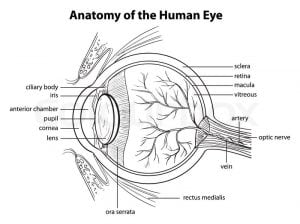

It’s possible for today’s contact lenses to fall out, though less commonly so. The old, hard contacts popped out frequently. Since the introduction of soft contact lenses and the advances in design and materials, this has really been reduced. About the only time you’ll experience contact lenses falling out is if the lens has not been correctly ‘fitted’ to your eye. During the contact lens fitting process the person doing the fitting, a dispensing optician, a contact lens fitter or an O.D., has the opportunity to see using florescien dye and a slit lamp whether or not the contact lens fits perfectly on your eye. Well-fitted contacts stay in place on the eyes and improve peripheral vision during sports and physical activity.

Very rarely can a contact lens break in the eye. If it occurs, this most likely this would happen during insertion or removal. In the even it does, rinsing out the eye with multi-purpose solution should remove any remaining pieces. Contact lenses are more prone to tearing, also typically during insertion or removal. The concept of ‘breaking’ is usually reserved for old, very rigid materials, not typically in use today.
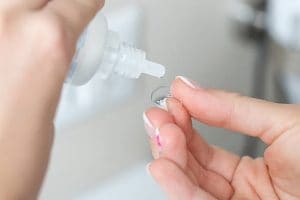
Yes, as long as it is a multi-purpose solution. Never put hydrogen-peroxide-based contact lens disinfection solutions in the eye. Multi-purpose solutions contain ingredients designed to disinfect, protect and clean contact lenses. Drops designed to lubricate the eyes however sometimes contain additional ingredients that target tear film health and stabilization, and as such lens cleaner is not intended as a replacement for eye drops and artificial tears.

Hepatitis is a disease that causes inflammation of the liver and may cause discoloration of the eyes (jaundice). If you have hepatitis, talk to your ECP, as this condition may affect your ability to wear contacts.
Diabetes elevates the risk for developing a number of vision problems including glaucoma and AMD (Age-related macular Degeneration). That being said, diabetes may affect your ability to wear contact lenses. Consult with your ECP to discuss your options.
Find the customer reviews & parameters on Acuvue Oasys for Astigmatism, Biofinity Toric, and other popular lenses on Lens.com

Yes. They’re made of plastic entirely. No animal products are used in their production.
No — or at least, they shouldn’t be. When they’re correctly fitted, you won’t even notice that you’re wearing contact lenses at all! Discomfort when wearing contact lenses indicates a problem and you should contact your ECP as soon as possible to schedule a refitting.
Wearing contact lenses is a personal decision. While some people prefer glasses to contacts, the benefits that come with contact lenses are many. If you’re worried about whether or not your contacts will be comfortable, talk to your ECP. He or she will be able to fit you with a pair that’s so comfortable you’ll hardly notice them.

No. Contact lenses are shaped a certain way so that they fit correctly in your eyes. If you flip your contact lens the other way and accidentally place it in your eye, you’ll most likely notice some discomfort. This is a sign that your contacts need to be removed and flipped the correct way for comfortable, optimal wear.